





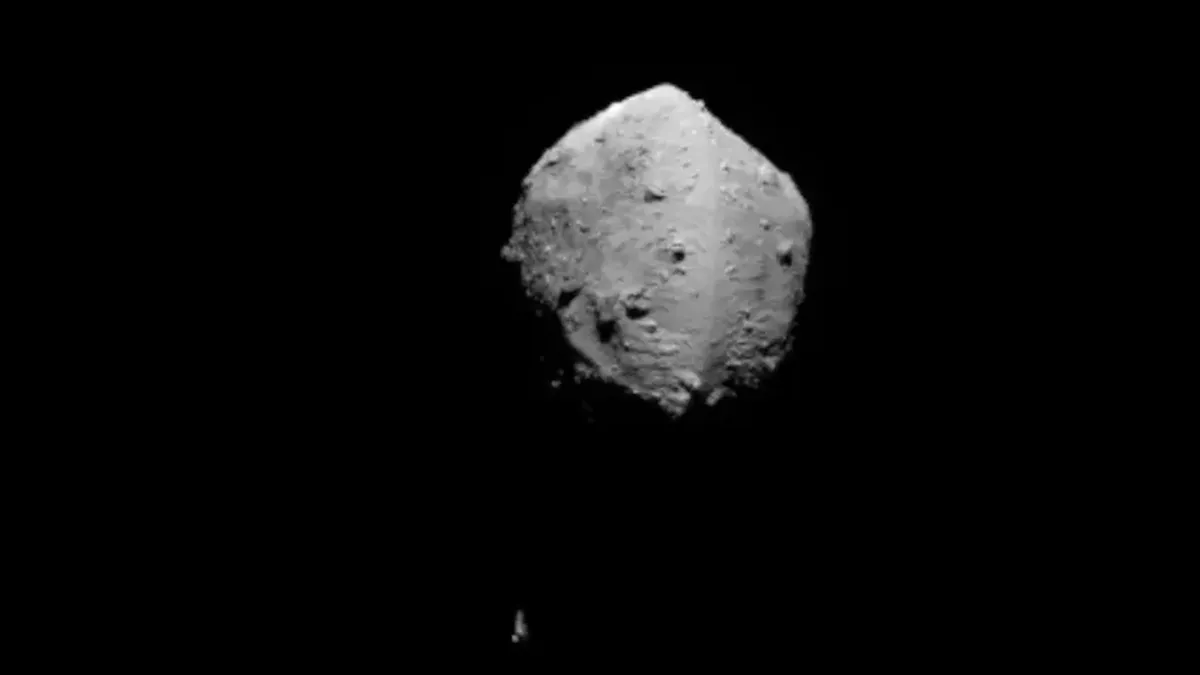
The European Space Agency's (ESA) Hera spacecraft has gotten its first close-up look at the Didymos binary asteroid system. If that system sounds familiar, it's because it made headlines in September 2022 when NASA's DART (Double Asteroid Redirection Test) spacecraft smashed into it.
The aim of the DART mission was to test whether an impact could divert an asteroid away from a collision course with Earth. The purpose of Hera is to follow up on DART by making up-close observations of the Didymos system.
"The first thing we said was, 'Wow,'" Hera Principal Investigator Patrick Michel said in a statement about the image, which ESA released on Thursday (Nov. 5). "This is the other side of Didymos from the one that DART’s camera showed us shortly before impact, so this feels like looking at a whole new world."
What is it?
The Didymos system consists of the eponymous 2,560-foot-wide (780 meters) space rock and its "moonlet" Dimorphos, which is about 530 feet (160 m) in diameter.
The DART mission impacted Dimorphos on Sept. 26, 2022, with the aim of causing a change in the orbital period of the moonlet. And it worked: Before the impact, Dimorphos completed one lap around Didymos in around 11 hours and 55 minutes. The DART collision reduced the length of this period by around 33 minutes.
The change is a result of the fact that Dimporphos is now traveling at around 2.7 millimeters per second more slowly than it did before the collision.
The newly released photo shows Didymos in detail. Just a sliver of Dimorphos is visible, below and slightly to the left of the main asteroid.
Why is it incredible?
The changes caused by DART were small. But in a real Earth-threatening scenario, even such a tiny shift could help divert an asteroid on a collision course — as long as scientists get enough advance warning of its approach.
Hera's observations should help reveal what other changes have occurred on and around Didymos.
Scientists are already seeing that, while Didymos has the same central ridge along its equator as before the impact, many changes have occurred. This includes the creation of multiple boulders, craters, and patterns of grooves or ridges.
"Since we expect a lot of impact-ejected material to have made it across the approximately 1 kilometer [0.62 miles] of space from Dimorphos to Didymos, it may be that some of these characteristics originate from this transport of material, and we have exciting work ahead of us to sort it out," said Michael Kueppers, ESA’s Hera mission scientist. "We look forward to seeing much more of both bodies and systemically mapping all the changes we identify."
Stay tuned to Space.com for more Hera findings from Didymos.