





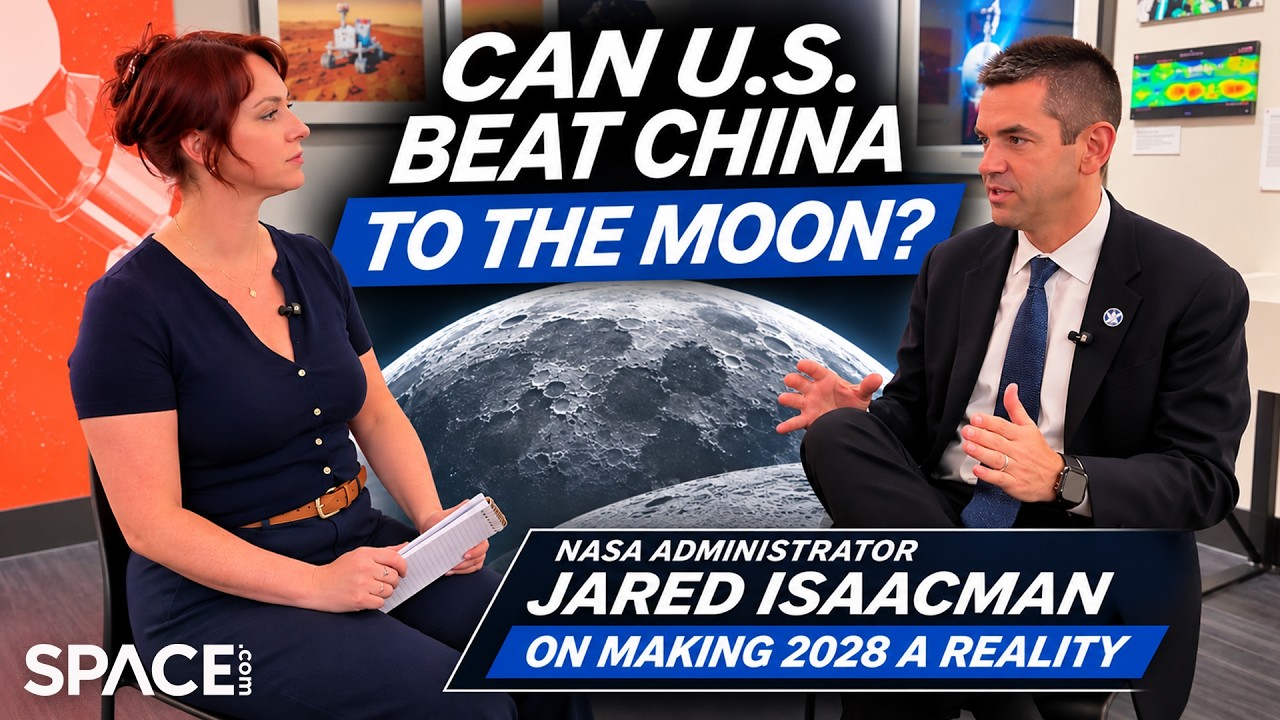
NASA Administrator Jared Isaacman is serious about launching "big rockets" to the moon every single year for the agency's Artemis program. And the new space race with China is fueling that ambition.
"I feel good. I feel like we are certainly on a more achievable path to the lunar surface today than where we were before," Isaacman told Space.com.
We recently sat down with the NASA chief to discuss the state of the Artemis program, and, off the bat, he made it clear that he's confident in the U.S. space program following the success of April's Artemis II mission around the moon. In fact, just prior to our conversation, it was announced that Artemis II commander Reid Wiseman will become the new deputy director of NASA's Jet Propulsion Laboratory. But the road from Artemis II's success to crewed lunar landings and, later, a permanent moon base will take a lot of launches of NASA's Space Launch System (SLS) megarocket, Isaacman stressed.
"You know, a lot of people, especially in the space community, start getting [into] if the landers are there or not. I don't really care about that right now. What I care about is that we are launching big rockets no less than once a year," he said.
"I think that's imperative for NASA to be doing these deep-space human spaceflight missions right now," Isaacman added. "So, we had a great mission in April of '26. We will launch again in '27."
That coming launch will be for Artemis III, a crewed mission to low Earth orbit that will test docking procedures between NASA's Orion capsule and one or both of the Artemis program's private lunar landers — SpaceX's Starship and Blue Origin's Blue Moon.
"We need to continue to exercise those muscles," he said, referring to SLS liftoffs. "And, honestly, once a year isn't great, either. I mean, I don't think we're going to get back to the early [space] shuttle days, you know, four missions a year. I don't think we're going to get back to where we were with Apollo, but once a year is the minimum … I would testify that to Congress in this role years down the road.
"If NASA is going to be doing deep-space missions, complicated missions, [we should] launch at least once a year and get as much out of it as you can for taking the risk and spending the taxpayer dollars and building towards something greater," Isaacman added. "That's what we're doing with Artemis III, and that's what's going to better prepare us for Artemis IV."
A new space race
So, how is NASA coping with the challenges that face them as they approach Artemis III ahead of a crewed lunar landing on Artemis IV, which is targeted for 2028? While NASA can learn some lessons from past moon missions with Apollo, today it's primarily relying on the extensive experience and talent within the agency, according to Isaacman.
"Artemis II is very different from Apollo 8, and Artemis III will be very different from Apollo 9," he said. "Our approach is not exactly the same as it was … But what is the same right now? The spirit, the energy, the potential within NASA. The talent of the workforce and industry is no different than the 1960s."
There's another similarity to the Apollo era: NASA has a rival in its race to the moon. While the adversary in the 1960s was the Soviet Union, today the U.S. is competing against China.
"It is a real space race," Isaacman said. But, he added, "this one is very different than the first one."
"Everything is closer than it was, not just in space. I mean, we had the edge in computing [and] every one of the technology domains during the Cold War. Our capabilities were better by a mile," he said. "[But with] China, it's not [like that]. They're very close."
"We're saying we're going to land on the moon at the end of 2028. China is saying by the end of 2029," Isaacman added. "And it's like, Well, are they going to pull it off? Yes, they will. They've showcased their landers, their rovers, their suits, two-launch architecture with built-in reusability."
So NASA is taking the Chinese threat very seriously, according to Isaacman.
"The consequence of getting this wrong, I'm telling you — it's going to be felt around the world," he said. "It will call everything into question."
"Should I be using American superintelligence or AI? Should I be doing Chinese? Should I be buying their computers? Should I be [buying] ours? Buying their cars, their airplanes, their ships? Whose security guarantees to trust?" Isaacman added. "I think the implications are pretty severe, which is why we're taking it so seriously and putting such extreme focus on the mission right now. But we have that playbook of success, and I think we will prevail."