






SpaceX plans to catch the upper stage of its Starship megarocket for the first time ever today (Nov. 14), and you can watch the action live.
Starship launched on its 15th test flight on Friday evening (Nov. 13), rising into the sky from SpaceX's Starbase site in South Texas. The mission plan called for bringing both of the vehicle's stages back to Starbase and catching them with the launch tower's "chopstick" arms — an unprecedented total recovery of an orbital rocket.
That didn't happen, however; SpaceX diverted Starship's Super Heavy booster to a controlled splashdown in the Gulf of Mexico 6.5 minutes after launch. (SpaceX said later that a guidance and navigaton issue during its descent triggered and automatic abort. But a catch of the Ship upper stage is still on the table, and that would be historic in itself: SpaceX has never tried it before.

The Ship catch is scheduled to occur today at around 4:20 p.m. EST (2120 GMT; 3:20 p.m. local Texas time) — roughly 22.5 hours after Flight 15 lifted off. You can watch it live here at Space.com.
There's no guarantee that it will happen, however: If SpaceX detects anything off-nominal with Ship, it will scrap the catch attempt, as it did with Super Heavy on Friday afternoon. We'll just have to wait and see.
SpaceX, however, seems confident. Flight controllers decided early Saturday morning, about seven hours after liftoff, to forgo a second window to end the mission early with a splashdown off the coast of Chile.
"Starship's going to stay in space. We are one step closer to an eventual return to launch site," SpaceX spokesperson Dan Huot said in a live commentary update. "So that's great news."
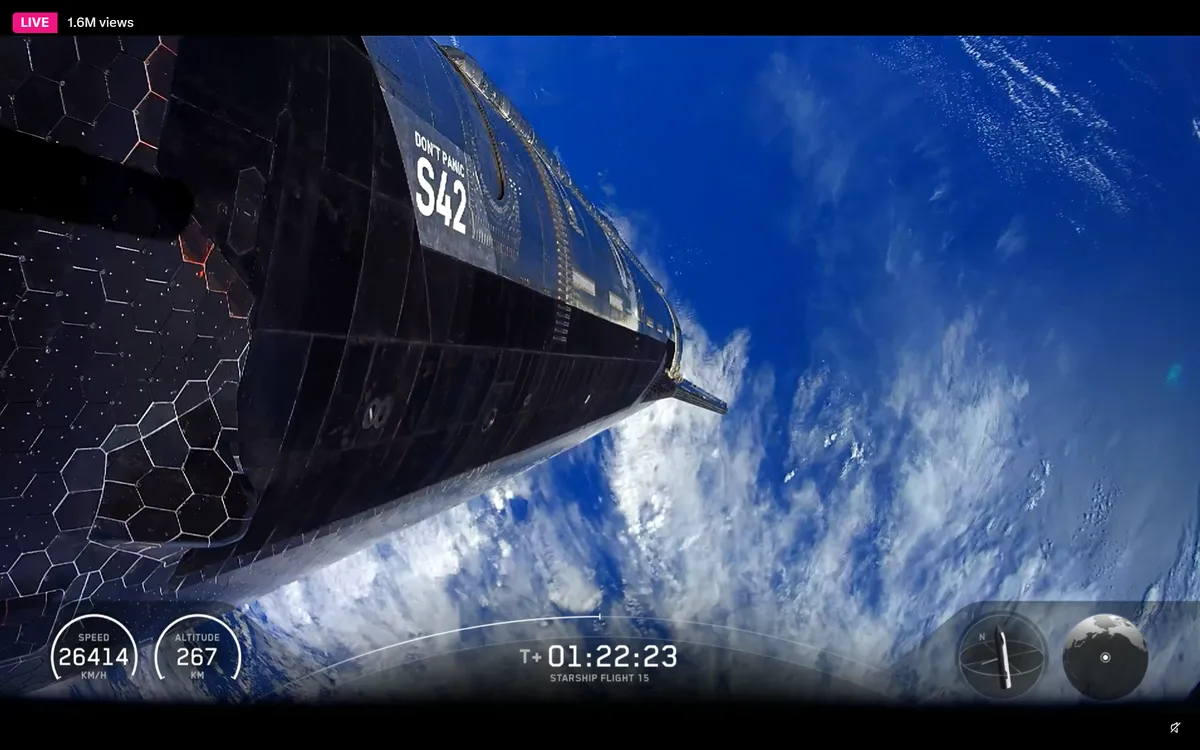
While the double-catch attempt was Flight 15's main headline, the mission had other objectives as well. One was getting Ship to orbit, which had happened on just one previous Starship launch — Flight 14, which lifted off on Sept. 28.
Ship deployed 26 of SpaceX's next-gen Starlink V3 broadband satellites in low Earth orbit (LEO) on Flight 14, and it did so again on Flight 15. These 52 spacecraft are the first members of a constellation that will eventually consist of 100,000 satellites, if all goes according to SpaceX's plan.
Some of those Starlink satellites took video and images of Starship's heat shield to check its health for today's landing attempt. Those images, combined with ground-based cameras, found the Ship in good shape. the company said.
"Our heat shield team reviewed all the data we got from our ground tracking cameras, and from those satellite cameras and confirmed the heat shield is in a good posture for a reentry and return to the launch site," Huot said.
And SpaceX plans to use Starship to build an even bigger network in LEO — Starmind, an AI data-center constellation that will harbor a million spacecraft, according to Elon Musk. (For context: SpaceX's current-gen Starlink network employs about 11,000 satellites at the moment.)
Assembling these megaconstellations will require an incredible launch cadence. And the double chopstick catch is key to that vision, SpaceX says, for it will enable quicker inspection, refurbishment and reflight of Starship.
So the company will doubtless try the maneuver again soon — probably on the next Starship flight, which won't be too far down the road.
Editor's note: This story was updated at 8 a.m. EST to include new details on SpaceX's Starship Flight 15 mission from SpaceX. Space.com Editor-in-Chief Tariq Malik contributed to this report.