
Latest articles by Joe Rao

This month, let's turn our attention to two celestial objects that can readily be seen even from bright cities. One is our nearest neighbor in space, while the other is a familiar pattern of stars.

Summer will officially arrive in the Northern Hemisphere on Thursday (June 20) at 4:51 p.m. EDT (2051 GMT) — the June Solstice. Here's what you need to know.

Saturn will appear just above the third quarter moon in the sky in the early hours of Friday (May 31).

Skywatchers who plan to rise early and step outside on June 3 expecting to see a stunning display of visible planets will be quite disappointed, at the very least.

For nearly a century, the 1887 book "Canon of Eclipses" was considered to be the authoritative work on solar and lunar eclipses.

By the end of this summer, we may have a good idea as to whether we'll have a bright naked-eye comet gracing our early autumn evening sky, known as C/2023 A3 (Tsuchinshan–ATLAS).

For the third time this year, the bright red star Antares will be occulted or hidden by the moon on Thursday, May 23.

The International Space Station, the largest and brightest object now orbiting Earth, will provide excellent views for skywatchers across much of the Northern Hemisphere for much of May.

The Eta Aquarid meteor shower peaks on May 5, and this year looks favorable for a good light show put on by bits of Halley's Comet as they burn up in Earth's atmosphere.

Along with Leo, there are two other members of the cat family that are currently well situated and close together in the evening sky: Leo Minor, the Smaller Lion, and Lynx.

The annual Lyrid meteor shower peaks overnight on April 21-22, but unfortunately a bright moon will make it difficult to spot any 'shooting stars' this year.

All you'll need to see comet 12P/Pons-Brooks this month, besides fair weather and a little luck, are good binoculars or a telescope and sky map to help guide you.

Jupiter and a slim crescent moon are the stand-out night sky sight in the evening sky right now.

What does the weather look like for the April 8 total solar eclipse? Here we take a look at the national weather forecast to find out.
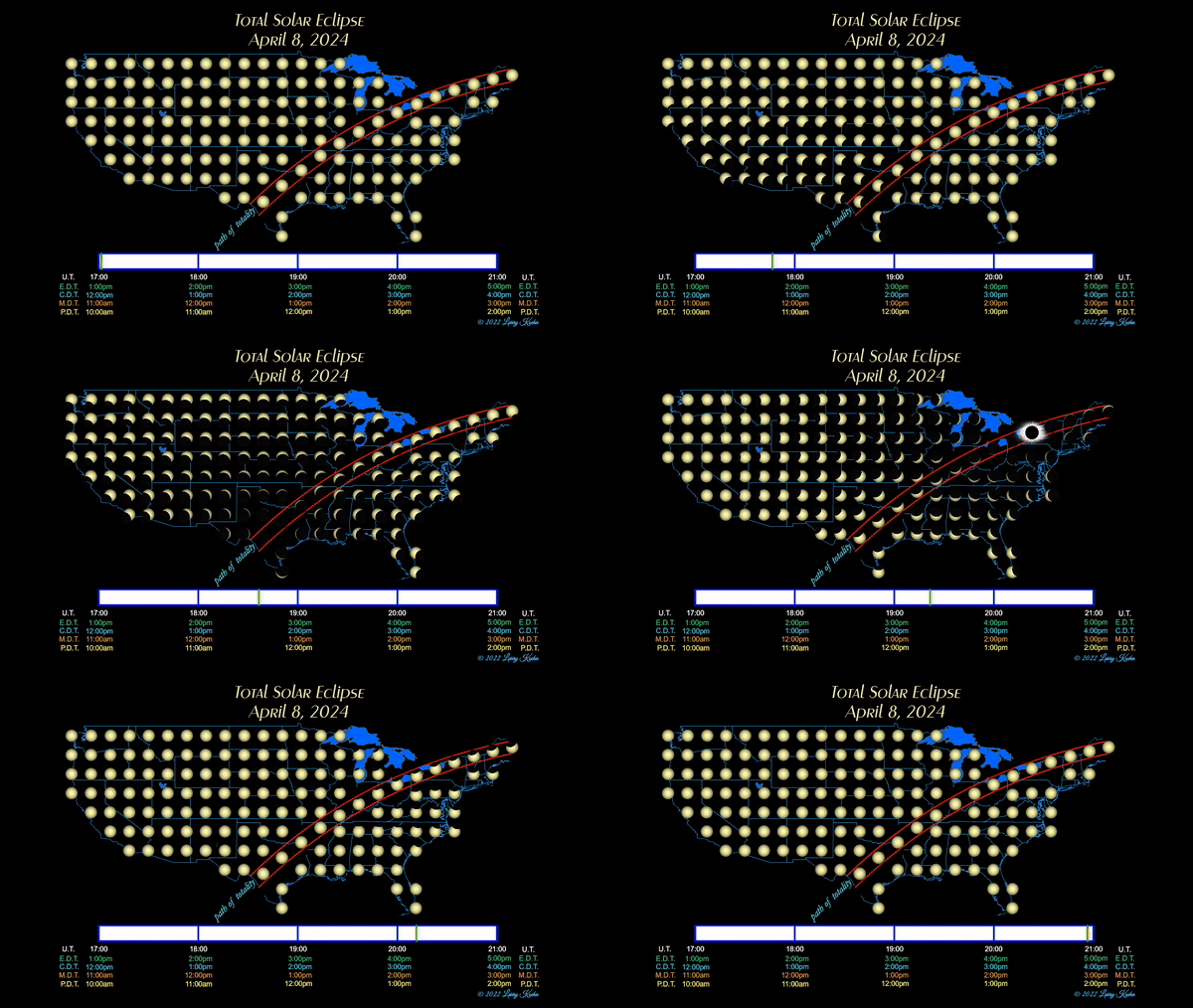
On April 8, 2024, if the weather is fair, you should have no difficulty observing a partial eclipse of the sun from much of North America - even outside the path of totality.

Here's why clouds might not be a big issue for the total solar eclipse on April 8 and what you can see if they decide to make an appearance.

When the total solar eclipse travels across North America on April 8, the skies will darken. Here's what to look for during totality.

We explore how eclipses repeat and what it takes to earn a 'black belt' in eclipse chasing, according to our skywatching columnist Joe Rao.

Two weeks before the total solar eclipse, during the overnight hours of March 24 - 25, it will be the moon's turn to undergo an eclipse.

Everyone is hoping for clear skies for the solar eclipse on April 8. Here we look at past examples of when this didn't work out and how to increase your chances of good eclipse weather.

As we prepare for the upcoming solar eclipse on April 8, we take a look at some famous incidents of viewing total eclipses near the edge of totality.

As the solar eclipse approaches, we take a look at some alternative methods of viewing the eclipse.

On March 19, the vernal equinox will see spring come to the Northern Hemisphere as the sun reaches the spot where the ecliptic and celestial equator cross each other.

