
Latest articles by Sharmila Kuthunur
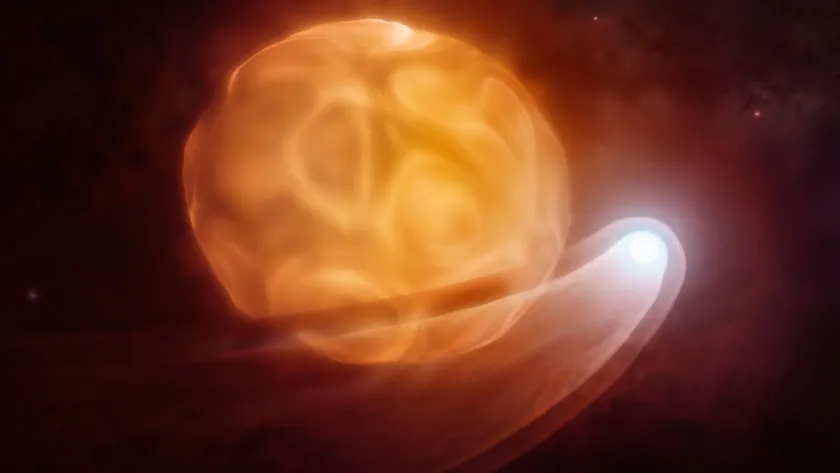
Radio images show the supergiant's atmosphere recovering from its dramatic dimming, while a companion plows through its outer layers.

NASA's OSIRIS-REx asteroid-sampling mission formally ended on Sept. 30, 2026, though scientists will continue to study the pieces of space rock it returned for decades.

A citizen science project is seeking volunteers to comb through NASA telescope data for telltale signs of the galaxy's hidden black holes.

In March 2028, the UAE is set to launch an ambitious mission to the asteroid belt between Mars and Jupiter that will culminate with a landing attempt on a mysteriously reddish space rock.

A new study points to different formation paths for Earth and Mars, despite their shared neighborhood.

A new look at ancient rocks suggests that a self-sustaining nutrient cycle in ancient oceans helped keep Earth's atmosphere rich in oxygen for millions of years.

"It passes through our bodies, our cells and every living organism on the planet, yet we know surprisingly little about whether and how this invisible force affects the way our cells work."

On a morning train commute, this former scientist found a stellar surprise in an old Hubble image.

Here's a rundown of all the major parts of NASA's Roman Space Telescope launching Aug. 30.

"We're not just studying astronomical objects anymore; we're using them to test the laws of nature."

NASA has invited the Indian Space Research Organisation to collaborate on its Moon Base program, which aims to build a permanent human outpost near the lunar south pole.

That's three times longer than the Milky Way galaxy.

"This helps future missions interpret what they find and better understand where to look for signs of habitability."

"It doesn't require any new technology development, which is almost unheard of for solving a LIGO instrumentation problem."

"We didn't anticipate big discoveries, given how extensively the planet has been studied, but we did complement Mars science with the data we collected through Psyche's unique perspective."

Despite being separated by billions of miles, Saturn's moon Titan and the dwarf planet Pluto share an unexplained surface signature.

New images from the European Space Agency's Mars Express orbiter have captured strange-looking waves on the Red Planet.

Backed by a $1.1 billion valuation, Skyroot Aerospace is betting that its Vikram-1 rocket can help transform India's commercial launch industry. And Vikram-1 is set to fly soon.

When the sun swells into a red giant about 5 billion years from now, Earth may escape being swallowed by the dying star, a new study suggests.

Ninety percent of the world's population could glimpse asteroid Apophis during its once-in-a-millennium close approach to Earth in 2029.

Researchers combined satellite data and visitor surveys at dark-sky parks to quantify the economic value of dark skies amid rising light pollution.

A new study reveals why black holes let out massive radio "burps" years after eating stars, giving astronomers a chemical blueprint to predict them early.

NASA's MAVEN Mars mission ended after 11 years, having revealed how the planet lost its atmosphere and served as a key communications relay for surface missions.

