
Latest articles by Sharmila Kuthunur

A glass bead retrieved by China's Chang'e-5 lunar mission is offering a glimpse into the moon's hidden interior and violent past.

Astronomers have caught a black hole far from the center of its galaxy ripping a star to shreds — offering for the first time evidence of a rogue supermassive black hole in action.

The brilliant blue-white star lighting up the red nebula Sh2-46 hints at a dynamic and possibly fleeting encounter that could reshape the nebula's appearance over time.

Earth's atmosphere pulses in sync with the sun's fiery outbursts, indicating it is more sensitive to solar activity than previously thought, according to new research.

"It's a rare opportunity to place our own solar system in a broader galactic context."

An independent analysis of recent data from K2-18b casts doubt on claims of detecting alien life on the distant exoplanet.

Astronomers have captured the sharpest, most detailed images yet of young solar systems where planets are just beginning to take shape.

Cosmic echoes from some of the universe's most violent collisions are far more nuanced than scientists had realized, according to new research.

Artificial intelligence could offer a powerful pathway to supercharge our ability to "hear" the universe, according to new research.

"With only lunar soil and a basic ingredient from the sun — which is always spitting out hydrogen — there's a possibility of creating water."

As scientists and space enthusiasts commemorate the Hubble Space Telescope's 35 years in orbit, the mission team joined in by delivering a fresh collection of awe-inspiring images.

A powerful new instrument added to the Daniel K. Inouye Solar Telescope promises to maximize the information gleaned from the sun's light.
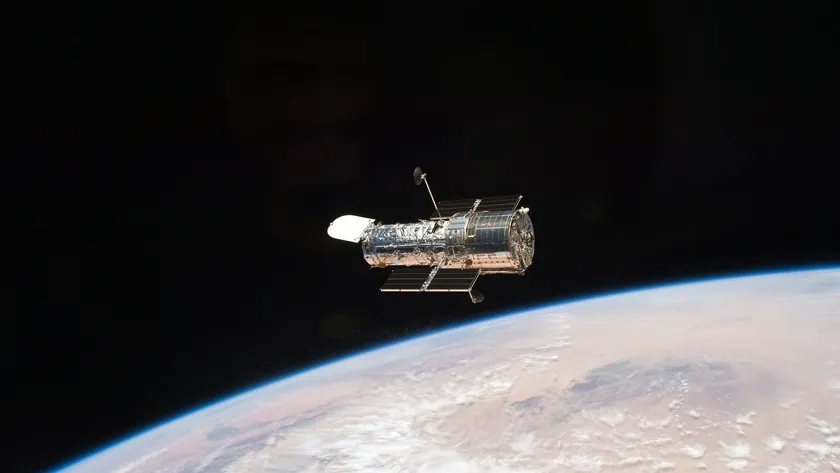
To mark the 35th anniversary of the Hubble Space Telescope, Space.com looks at some of the most scientifically significant images that have emerged from the observatory's lens.

NASA's Lucy spacecraft, currently journeying toward Jupiter's orbit on its asteroid-hopping mission, captured an impressive close-up of its second target: the main belt asteroid 52246 Donaldjohanson.
Sponsored
Last week, scientists announced they found the "strongest evidence yet" of alien life beyond our solar system. However, the scientific community remains skeptical.

Astronomers have stumbled upon yet another ghostly galaxy that appears to be devoid of dark matter, the elusive stuff that makes up most of the material universe.

AI can bridge the growing gap between new and old solar observations and help scientists uncover overlooked aspects of our star's long-term evolution, a new study argues.

NASA's Perseverance rover is reveling in a scientific bonanza on Mars after finding a diverse array of rocks that are providing eager scientists a glimpse into the planet's ancient history.

A stunning new image from the James Webb Space Telescope is allowing astronomers to examine the complex and turbulent final stages of a dying star.

A nearby Earth-sized planet beyond our solar system could soon add to the diversity of known terrestrial worlds with their own "air."

Asteroid 2024 YR4, once a potential Earth threat, likely originated from the main asteroid belt's central region, a surprising origin for Earth-crossing space rocks, a new study finds.

"A future conflict in space could have massive, long-term negative repercussions that are felt here on Earth, as everyone on this planet is a user of space data in some form."

This approach can now be used to determine the rotation rate of any celestial object with a magnetic field and auroras — including exoplanets.

